Five things you need to know about orthognathic surgery during summer vacation!
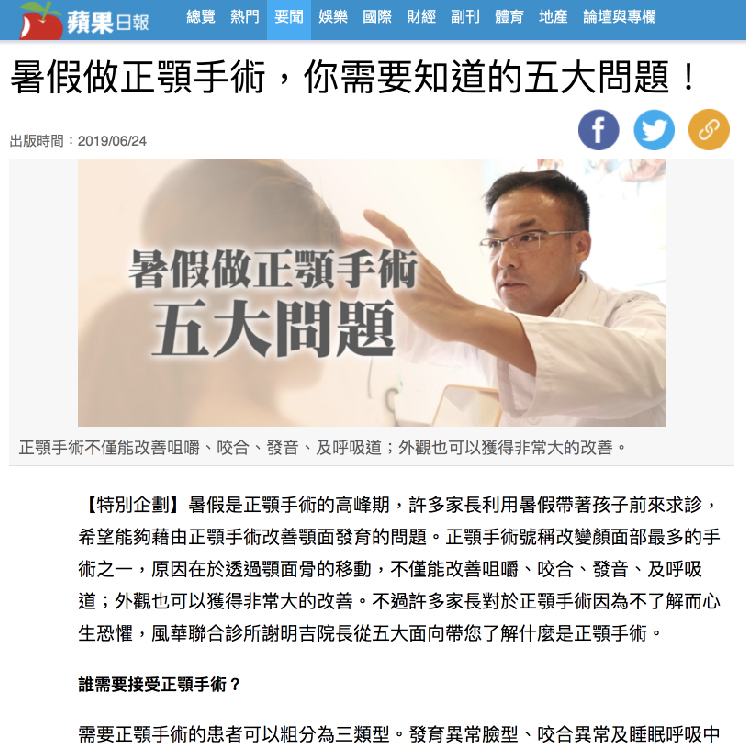
Summer vacation is the peak period for orthognathic surgery. Many parents use the summer vacation to bring their children to seek medical treatment, hoping that orthognathic surgery can improve the development of the jaw and face. Orthognathic surgery is known as one of the surgeries that change the face the most. The reason is that through the movement of the maxillofacial bones, not only can chewing, bite, pronunciation, and respiratory tract be improved, but the appearance can also be greatly improved. However, many parents are afraid of orthognathic surgery because they do not understand it. Dr. Adrian M. Hsieh, the director of Fenghua United Clinic, will help you understand what orthognathic surgery is from five aspects.
Who needs orthognathic surgery?
Patients requiring orthognathic surgery can be roughly divided into three types. Abnormal facial development, abnormal bite, and sleep apnea.
The first type improves the abnormal development of the face shape. According to clinic statistics, most patients seek orthognathic surgery to improve their problems due to "bucket", overbite or unsightly facial contours, such as bucket face shape, protruding mouth with protruding teeth, excessive gum exposure and facial distortion. These abnormal development of the teeth, jaws and face are often accompanied by malocclusion, causing problems in pronunciation, chewing, digestion and other aspects.
Patients with type II malocclusion. Generally, patients with bite abnormalities, if the degree is minor, can be treated with simple orthodontic treatment. If the severity of the problem is beyond the reach of orthodontic treatment alone, a combination of orthognathic surgery and orthodontic treatment may be recommended. There are also some bite problems that can be solved by orthodontic treatment alone, but may not be able to achieve the patient's ideal face shape; it is necessary to combine orthognathic surgery and orthodontic treatment to meet the patient's expectations.
The third type is sleep apnea treatment. Some patients commonly known as "chinless" actually suffer from sleep apnea due to the retraction of the mandible, which compresses the respiratory tract. During sleep, the respiratory tract is too narrow and cannot breathe air. They are often in a state of hypoxia, which makes them mentally depressed and may even lead to death! Orthognathic surgery expands the airway space by adjusting the facial bones, thereby treating the root causes of multiple obstruction points at one time. Therefore, patients with moderate to severe sleep apnea should be given priority.
Dr. Adrian M. Hsieh said: "For young male and female students, in addition to wanting to improve their physical symptoms, they also care more about the opinions of their peers. In the patient's self-reported growth process, there are many cases of being nicknamed, ridiculed, or subjected to some degree of bullying; thus causing the negative impact of psychological inferiority and timidity." Timely orthognathic surgery is an opportunity for change for patients with craniofacial abnormalities!
https://www.youtube.com/watch?v=Z32UPaqATjg

Can orthognathic surgery be performed immediately?
Dr. Hsieh said that in order to ensure that the bones are mature and stable and avoid recurrence due to subsequent growth, it is recommended that patients undergo surgical evaluation and correction when they reach adulthood or after their growth is completed. Generally speaking, it is recommended that patients are over 18 years old, unless there are psychological factors or other special considerations. Furthermore, pregnant women and patients with cardiovascular disease and related special diseases must be evaluated by a specialist first.
Dr. Hsieh believes that "In the past, orthognathic surgery was mainly focused on improving the occlusion. The traditional concept was to perform a period of dental correction before undergoing orthognathic surgery to correct facial bone abnormalities. Nowadays, occlusion correction has been regarded as a basic need, and most patients hope to further improve the overall proportion of the appearance." With the advancement of medical technology, 3D computed tomography (CT SCAN) is used to confirm the patient's upper and lower jaw structure and preoperative occlusion. During the operation, the upper and lower jaws and occlusion can be accurately adjusted to a better position. Most patients can undergo orthognathic surgery directly after proper evaluation. After surgery, fine-tuning of the teeth can be done to achieve the desired treatment results.
Dr. Hsieh added that orthognathic surgery is not something that everyone can undergo immediately. Some people, after being evaluated by a physician, require a period of treatment by an orthodontist before they can undergo surgery. If you have this type of patient, it is recommended to see a doctor as soon as possible for evaluation and corrective treatment, and then you can start the orthognathic surgery course during the summer or winter vacation.

How to take care of yourself during the recovery period from orthognathic surgery?
With medical advancement, current technology has been able to significantly shorten surgery time and more accurately adjust and beautify the appearance. The operation takes about 3 to 4 hours, and you only need to stay in the hospital for one night for observation, and you can be discharged early the next morning.
The degree of swelling and the recovery period are not as painful as before. You need to adopt a liquid and residue-free diet in the first week; you can start eating softer and rotten foods after a week, and try to avoid irritating foods such as seafood and fried foods; you can return to a normal diet in about a month. Facial swelling will reach its peak within one week after surgery, and will gradually subside after one week. Most patients can return to work and school after two weeks, and most patients can resume normal daily life after four weeks.
Most patients feel slightly anxious within a week due to swelling and discomfort, and are unable to immediately see the appearance improvement brought about by orthognathic surgery. At this time, family or friends need to do a good job of psychological construction. Fung Wah United Clinic has also set up a special section called "Orthognathic Surgery - My Weekly Diary of Recovery" to collect recovery experiences shared by many patients. Dr. Hsieh said that through the special area, patients can share with each other the details or difficulties encountered during the recovery period of surgery, and it can also allow patients who are preparing for surgery to have reasonable expectations and greet themselves after surgery with a healthy and positive attitude!
https://www.youtube.com/watch?v=ddqbysKJe-8&

What are the risks of orthognathic surgery?
Dr. Hsieh also reminded that all medical procedures are accompanied by infection or other surgical risks.
The key is that most of the wounds opened during orthognathic surgery are in the mouth. Poor oral hygiene and improper daily routine after surgery will increase the chance of infection. However, taking medicine on time, paying attention to diet and keeping the wound clean can reduce the risk.
Secondly, the inferior alveolar nerve is injured. This nerve is located in the mandible. During the operation, due to vibration and pulling, even if the inferior alveolar nerve is not damaged, temporary paralysis may still occur, resulting in temporary delayed perception and unnatural expression after the operation. This is normal; through independent massage and expression exercises, most patients will gradually improve.
How to choose an orthognathic clinic? Choosing a doctor is also important!
Orthognathic surgery is a very professional medical surgery, and the surgical site is on the head and face, which people care about most. It is especially important to choose a professional doctor certified by the government.
Oral and maxillofacial surgeons have received many years of dental training and facial surgical training. Compared with plastic surgeons, they understand the dental occlusion condition better, how to communicate with orthodontists, how to understand the airway space from the occlusion of the face, the close relationship between orthognathic surgery and the temporomandibular joint, etc. To deal with these problems completely and thoroughly, it is necessary to integrate the knowledge and training of dental medicine and surgical medicine.
Fenghua United Clinic provides one-stop medical services, so that orthodontics and dental cosmetics after orthognathic surgery can be performed at the same place. In addition to professional oral and maxillofacial surgeons, full-face design evaluation can be combined with composite surgeries (temporomandibular joint, forehead, cheekbones, apple muscles, etc.), which not only solves appearance problems but also achieves a more harmonious surgical effect. In addition to adjustments and corrections, becoming more confident in oneself has always been the goal that everyone pursues!