Lean man's thunderous snoring turns out to be sleep apnea
2018-04-20 23:33United Daily News Dr. Scott H. Jiang Oral and Maxillofacial Surgeon, Fenghua United Clinic
Mr. C, 40 years old, snores loudly while sleeping, and his wife complains constantly. When he went to the hospital for examination, he was found to have severe obstructive sleep apnea syndrome. He loves kickboxing and has a medium-to-thin build. He never thought that he had this disease. He was unable to wear a positive pressure respirator for a long time and had no active treatment. He believed that he was not fat and his symptoms should not be serious and could be improved by exercising more.
Until recently, Mr. C found that he was forgetful, and his concentration and memory were not as good as before. After taking a sleep test again, he found that the sleep apnea index had worsened, causing severe brain hypoxia during sleep, with the lowest blood oxygen concentration as low as 44%.
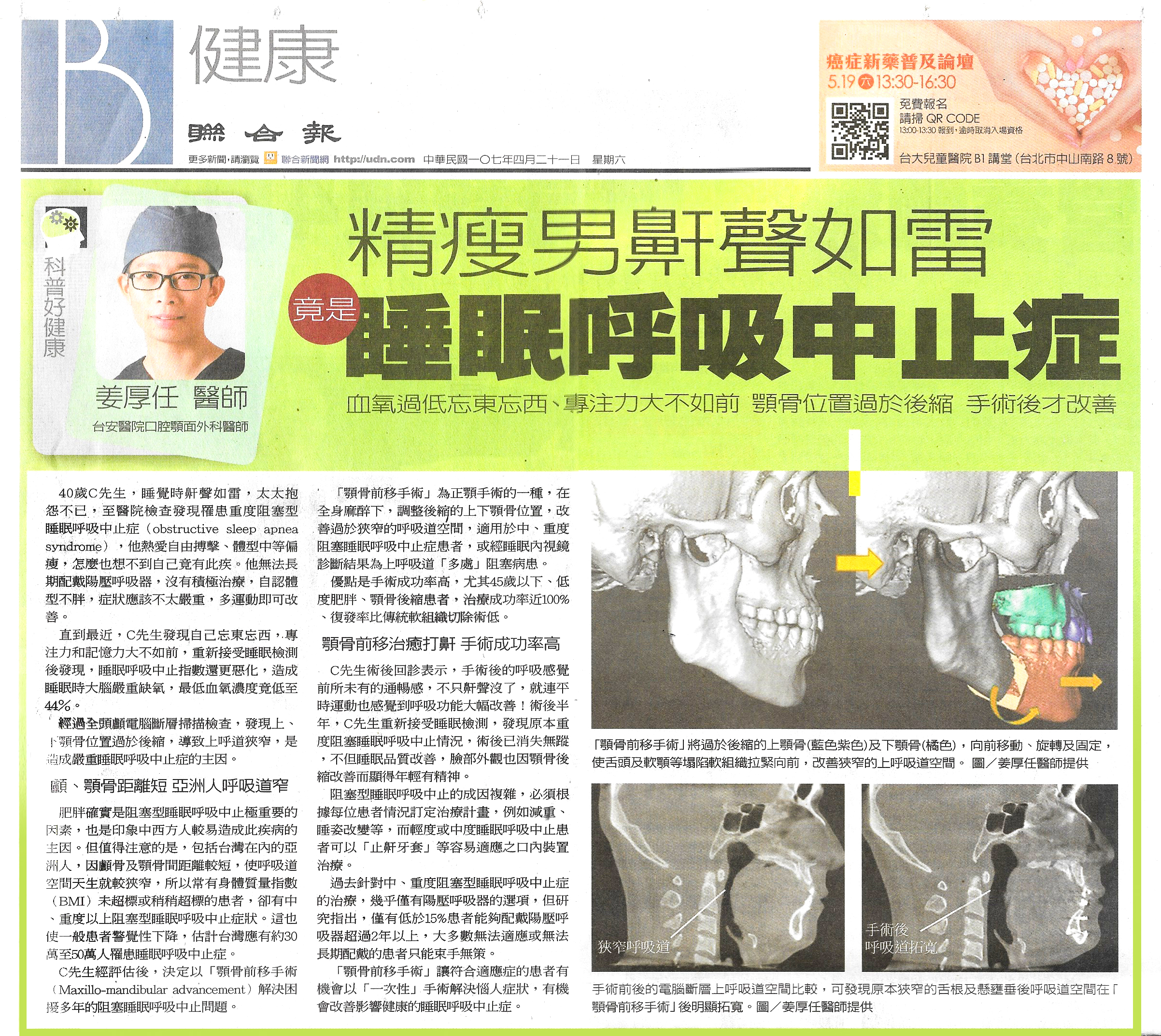
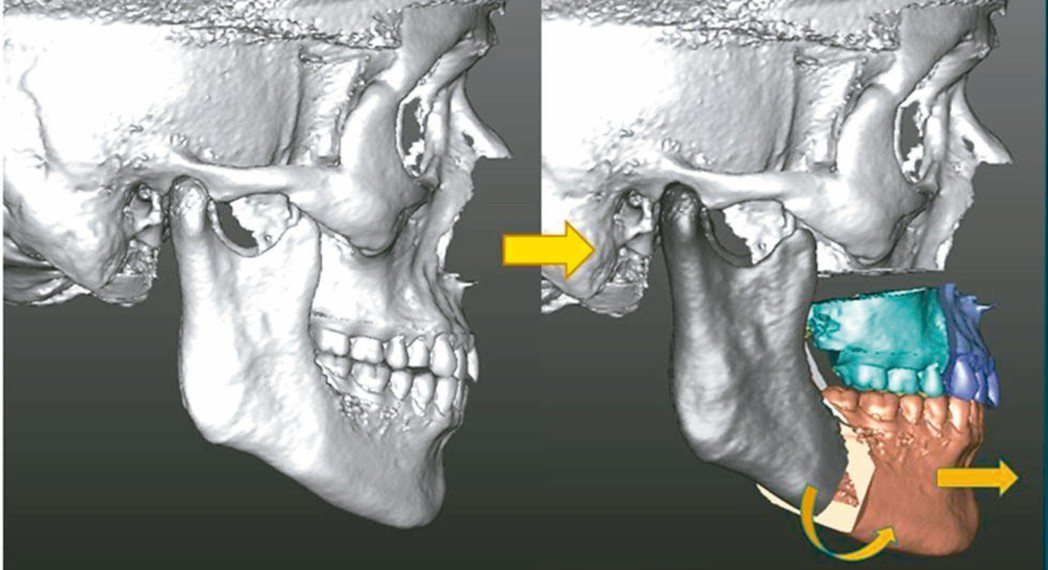
After a whole-head computed tomography scan, it was found that the upper and lower jaw bones were too retracted, resulting in narrowing of the upper respiratory tract, which was the main cause of severe sleep apnea.
The distance between the skull and jawbone is short, and Asians have narrow respiratory tracts.
obesityIt is indeed a very important factor in obstructive sleep apnea, and it is also the main reason why Westerners are more likely to suffer from this disease. However, it is worth noting that Asians, including Taiwanese, have a naturally narrow respiratory space due to the short distance between the skull and jawbone, so they often have body mass index (BMI) that is not exceeding the standard or slightly exceeding the standard.patient, but has symptoms of moderate to severe obstructive sleep apnea. This also makes the average patient less alert. It is estimated that about 300,000 to 500,000 people in Taiwan are suffering from sleep apnea.
After evaluation, Mr. C decided to use "jawbone advancement"Operation(Maxillo-mandibular advancement) solves the problem of obstructive sleep apnea that has plagued many years.
"Jaw bone advancement surgery" is a type of orthognathic surgery. Under general anesthesia, the position of the retracted upper and lower jawbones is adjusted to improve the too narrow airway space. It is suitable for patients with moderate to severe obstructive sleep apnea, or patients with "multiple" upper airway obstructions diagnosed by sleep endoscopy.
The advantage is that the surgical success rate is high, especially for patients under 45 years old, with mild obesity, and jaw retraction. The treatment success rate is nearly 100%, and the recurrence rate is lower than traditional soft tissue resection.
Jaw bone advancement cures snoring, surgery has high success rate
During the post-operative follow-up visit, Mr. C said that his breathing felt smoother than ever before. Not only did his snoring disappear, but his breathing function also improved significantly during daily exercise! Half a year after the operation, Mr. C underwent a sleep test again and found that his severe obstructive sleep apnea had disappeared after the operation. Not only did his sleep quality improve, but his facial appearance also looked younger and more energetic due to the improvement in jaw bone retrusion.
The causes of obstructive sleep apnea are complex, and a treatment plan must be developed according to each patient's situation, such as weight loss, sleeping position changes, etc. Patients with mild or moderate sleep apnea can be treated with easy-to-adapt intraoral devices such as "anti-snoring braces".
In the past, the only option for the treatment of moderate and severe obstructive sleep apnea was positive pressure respirators. However, studies have pointed out that only less than 15% of patients can wear positive pressure respirators for more than 2 years, and most patients who cannot adapt or wear them for a long time are helpless.
"Jaw bone advancement surgery" allows patients who meet the indications the opportunity to solve annoying symptoms with a "one-time" surgery, and has the opportunity to improve sleep apnea that affects health.
Dr. Scott H. Jiang/Oral and maxillofacial surgeon at Fenghua United Clinic